
Chat
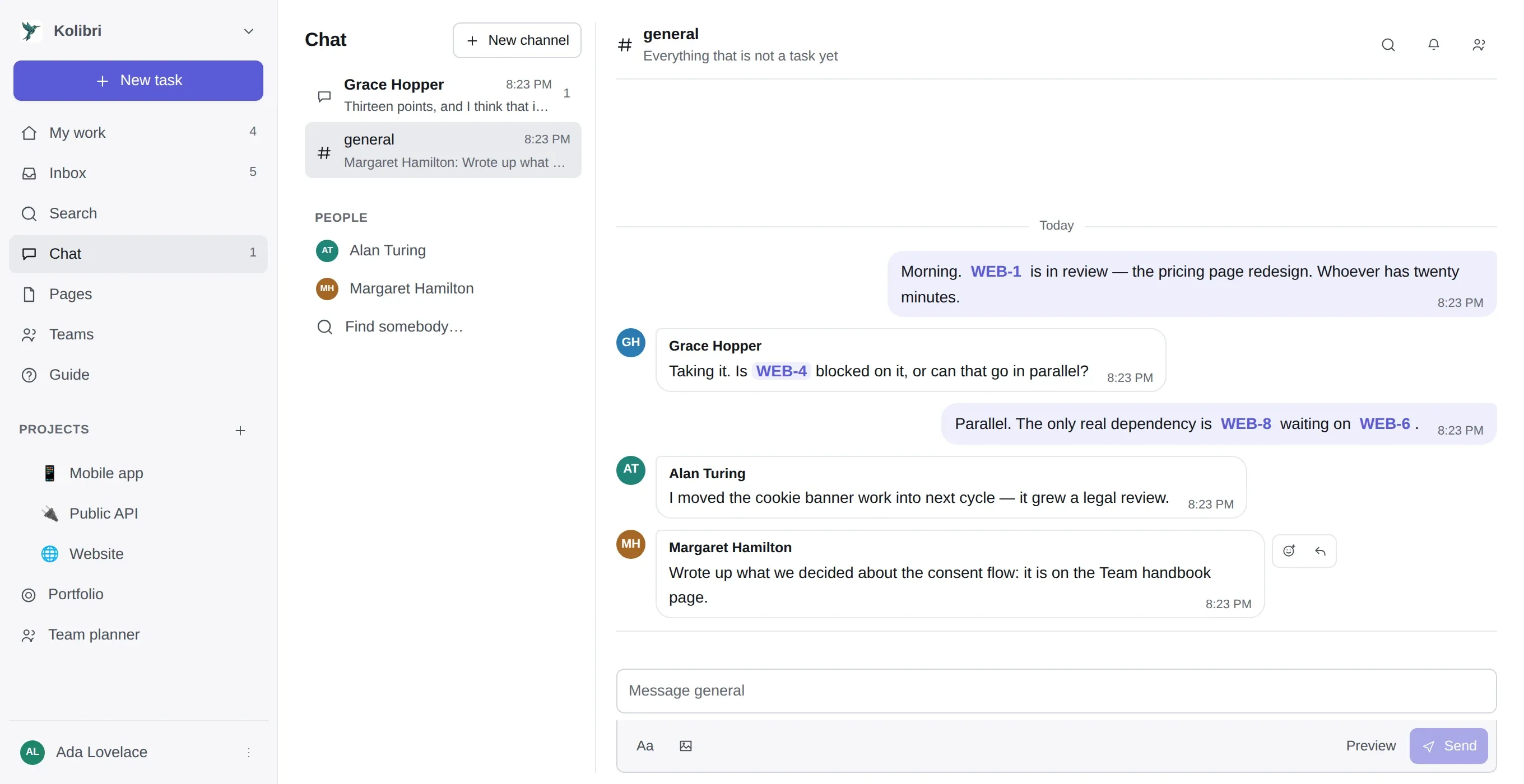
Chat in the sidebar. Channels and direct messages, built out of the same rows as tasks and pages.
That is not an implementation detail. A message being an ordinary synced row is why it sends from a train and arrives when the tunnel ends, why it appears on the other person’s screen without a socket to reconnect, why it survives a reload, and why it shows up in search and in a backup. There is no second protocol here to be down.
The two kinds
Section titled “The two kinds”| Channel | Direct | |
|---|---|---|
| Named | #design-review, lowercase and dash-joined |
No name of its own |
| Who is in it | The workspace, or a member list if private | Exactly two people |
| Who may change that | Per channel: anybody in it, or only its creator and admins | Nobody — its members are its identity |
| Where it lives | The workspace, or a project | Nowhere |
| Notifies | When you are named, or if you asked for all of it | Always, unless you say otherwise |
Three or more people is a private channel with a name, not a bigger direct message. That is a product decision and a technical one at once: a direct conversation is identified by the two people in it, which is what lets both of them open it while offline and end up in one room rather than two half-rooms.
Writing
Section titled “Writing”The composer is the same editor as comments and page bodies:
- Paste or drop a screenshot straight in. It uploads, downscales and goes in as markdown.
WEB-42becomes a link to that task and#WEBto that project; typing#offers both. Clicking one opens the task as a sheet over the conversation.@somebodynames them, which is what makes a channel notify them.- React to any message with an emoji, including somebody else’s. That is the one thing you may do to another person’s words, and it is not a change to them.
- Reply to a specific line.
Being told about it
Section titled “Being told about it”The default is deliberately not tell everyone about every line. A channel that pings its whole membership on every message is a channel people mute, and a muted channel tells nobody anything.
- A channel notifies whoever was named with
@, plus anybody who asked for all of it. - A direct message notifies the other person — being written to directly is exactly the case where silence would be wrong.
- Muting beats a mention. Somebody who set a conversation to nothing means it.
Per conversation, in the bell menu at the top of it. Where you have got to is private to you; there are no read receipts.
Message notifications count as important for the instant channels — Telegram and Web Push — and deliberately not for email, because email here is batched on purpose and a chat message that arrives in a two-hour summary is one answered too late to matter. See notifications.
Unread
Section titled “Unread”Counted on your device from rows it already has: messages newer than your read marker, not counting your own. It is right while offline, and the marker only ever moves forwards — a marker that went backwards would make a conversation you have just read unread again on your laptop.
Private channels
Section titled “Private channels”A private channel keeps a member list, and who may change it is set per channel: anybody in the room, or only its creator plus workspace admins. Per channel, because a team channel and a channel a client can see want different answers and the same workspace holds both. Changing the setting is itself an admin decision, or it protects nothing.
Two rules hold whatever the policy says:
- Leaving is always yours to do. A room you cannot leave without permission is not one anybody should be added to.
- The last person out cannot leave the room standing empty, because it would be invisible to everybody and impossible to reopen.
Archiving and deleting
Section titled “Archiving and deleting”Archiving hides a channel and refuses new messages, keeping everything said in it. Deleting hides it the same way — it does not destroy the conversation. Both are reversible from the trash until an admin empties it.
A chat history is often the record of a decision, so nothing here throws one away on a single click.
Deleted messages are the one thing not listed in the trash. A message somebody withdrew should stay withdrawn, and a list of them would be a way to read exactly that.
Presence
Section titled “Presence”A green dot says who is here and a line says who is typing. Both are held in memory rather than stored, and carried on the connection the app already has — so neither is a row, neither is in a backup, and neither works offline, which is correct: presence is a claim about right now.
What is deliberately not here
Section titled “What is deliberately not here”No threads, no voice, no video, no calls, no read receipts, no message editing history. Chat here is the conversation around the work, sharing the work’s plumbing — not a second product.